
How much should a trade business spend on Facebook ads?
How much should a tradesman spend on Facebook ads? It depends on what one booked job is worth and how many jobs you want. Here is how to work it out, with our own £20-a-day campaign as a worked example.
Free 20-minute call. No contracts pushed. Takes 30 seconds.
The honest answer: it depends on job value
Most guides give you a number and move on. We will not. How much a tradesman should spend on Facebook ads depends on what one booked job is worth to you, and how many jobs you want.
A roofer booking a full re-roof can afford a very different budget to a window cleaner charging per visit. Same platform, different maths.
We run Facebook ads for our own exterior cleaning business, so this guide comes from real spend, not theory. By the end you will know how to work out a budget for your trade, what to expect, and when to scale.
Prefer us to do the sums with you? Book a free marketing review and we will go through it for your area.
Start with the maths: jobs, leads, cost per lead
Work backwards. It takes five minutes and stops you guessing.
Step 1: pick the number of jobs you want
How many extra jobs a month would fill your diary? Be realistic. Ten extra jobs is a better target than a hundred.
Step 2: work out how many leads that needs
Not every lead books. Some do not answer, some want a price only, some are outside your area. Count how many of your last enquiries turned into jobs. That figure varies a lot between trades, so use your own, not someone else’s.
Step 3: estimate your cost per lead
Cost per lead is what you pay Meta for each enquiry. It changes by trade, area, offer and season, so treat any number you read online, including ours, as a guide only. Our cost per lead guide explains how to work yours out.
Step 4: multiply it out
Leads needed multiplied by cost per lead gives your monthly ad spend. Divide by 30 for a daily budget.
Here is the simple version, using our own £7.42 cost per lead as a stand-in. It is arithmetic, not a forecast. Your cost per lead will differ.
| Over 30 days | What to expect | |
|---|---|---|
| £10 a day | £300 spend, about 40 leads | Slow to learn. Fine for a small test. |
| £20 a day | £600 spend, about 81 leads | Where we started our own ad. Enough data to optimise. |
| £30 a day | £900 spend, about 121 leads | Good for busy areas or higher competition. |
| £50 a day | £1,500 spend, about 202 leads | Scale here once jobs are booking and the diary has room. |
Notice the pattern. Spending more only helps if the leads turn into booked jobs. That is the number that matters, not clicks or reach.
- Know what one booked job is worth to you
- Know roughly how many leads turn into jobs
- Set a daily budget, not a lump sum
- Judge on booked jobs, not clicks
Our own worked example: £20 a day for 2 weeks
We do not just write about this. We ran it on our own roof cleaning service.
We put £20 a day behind one Meta lead ad for 2 weeks. We spent £281.80 in total and got 38 leads at £7.42 each. The ad reached 24,884 people across 30,136 impressions.
Those leads turned into £8,450 of booked roof cleaning jobs. That is our own result, on our own business, in our own area. We are not promising you the same, because trades, areas and offers differ.
Our own roof cleaning ad, £20 a day for 2 weeks.
A steady budget keeps cost per lead steady too. In the 30 days to 28 September 2026, our roof cleaning leads campaign brought in 48 leads at £7.43 each from £356.40, almost the same cost per lead as the 2-week test.
Look at what this tells you. The budget was modest. The ad was specific. The lead went straight to WhatsApp so we could call fast. Budget alone did not do it. Our results page shows the full story.
We spend our own money on our own ads first. If it does not book us jobs, we do not sell it to you.
Why too little fails and too much wastes
Why £5 a day starves the algorithm
Meta learns who is most likely to enquire by watching what people do with your ad. It needs enough activity to spot patterns. At £5 a day you might get a few leads a week. That is too little data, so results stay patchy and it takes far longer to know what works.
Small budgets also hide problems. If you get two leads in a week and one is a dud, you cannot tell whether the ad, the offer or the area is the cause.
Why £100 a day on day one wastes money
The opposite mistake is just as costly. Starting big feels bold, but you have not yet tested your ad. If the headline is weak or the offer is unclear, you pay a lot to find that out.
A big budget also pushes Meta to reach further, often into people who are not ready to book. Cost per lead can climb and lead quality can drop.
The middle path
Start at a sensible level, prove the ad books jobs, then raise the budget. That is how we run our own ads, and how we run them for others.
Budgets by trade type: low, medium, high ticket
Job value shapes budget more than anything else. Here is a rough way to think about it. These are not prices or targets, only a way to frame the decision.
| Typical jobs | How to think about budget | |
|---|---|---|
| Lower ticket | Gutter clears, window cleaning, small repairs | Lower cost per job, so you can afford more leads. Volume matters. |
| Medium ticket | Driveways, decking, painting, garden work | Moderate value. Start in the middle and watch booked jobs. |
| High ticket | Roofs, extensions, kitchens, rewires | Fewer leads needed. Each booked job covers months of spend. |
Low-ticket trades
Window cleaners, gutter clearers and similar services need volume. Each job is smaller, so the cost per lead has to stay low and follow-up has to be quick. Repeat customers help a lot, because one lead can become a round.
Medium-ticket trades
Driveway cleaning, painting and landscaping sit in the middle. A steady daily budget works well. Judge it on booked jobs after two weeks.
High-ticket trades
Roofing, building and kitchen fitting need fewer leads, but each one is worth more. You can often afford a higher cost per lead, so a bigger budget may make sense. See how this plays out for roofers.
Whatever your trade, work out the value of a booked job first. It makes every other decision easier.
When and how to scale
Scaling is where people lose money. The rule is simple: scale what works, slowly.
- Leads are turning into booked jobs, not only enquiries
- You have room in the diary for more work
- Cost per lead has been steady for at least a week
- You can answer new leads fast, ideally within minutes
Raise in small steps
Raise the daily budget a little at a time, never double it overnight. Then wait a few days. Big jumps can reset Meta’s learning and push cost per lead up.
Add, do not just stretch
Once one ad works, add a second ad for a different service or town rather than pushing one ad harder. Fresh creative keeps results steady. Our Facebook and Instagram ads service includes new creative as you grow.
Know when to hold
If the diary is full, do not raise the budget. More leads are not always the goal. Better jobs at better prices can be. Jordan at Hewitt’s Exterior Cleaning found exactly that.
Big thanks to the Grafter Media team 🙌 I've raised my prices and I'm still booked out. The biggest mistake I made was not running ads sooner.
 JordanHewitt's Exterior Cleaning, Essex
What else affects cost per lead
Budget is only one lever. These matter just as much.
Your offer
A clear, specific offer beats a vague one. “Free roof moss check” gives people a reason to act. “Roofing services” does not.
Your area
Postcode targeting changes cost. A small, well-chosen area is usually better than a whole county.
Your creative
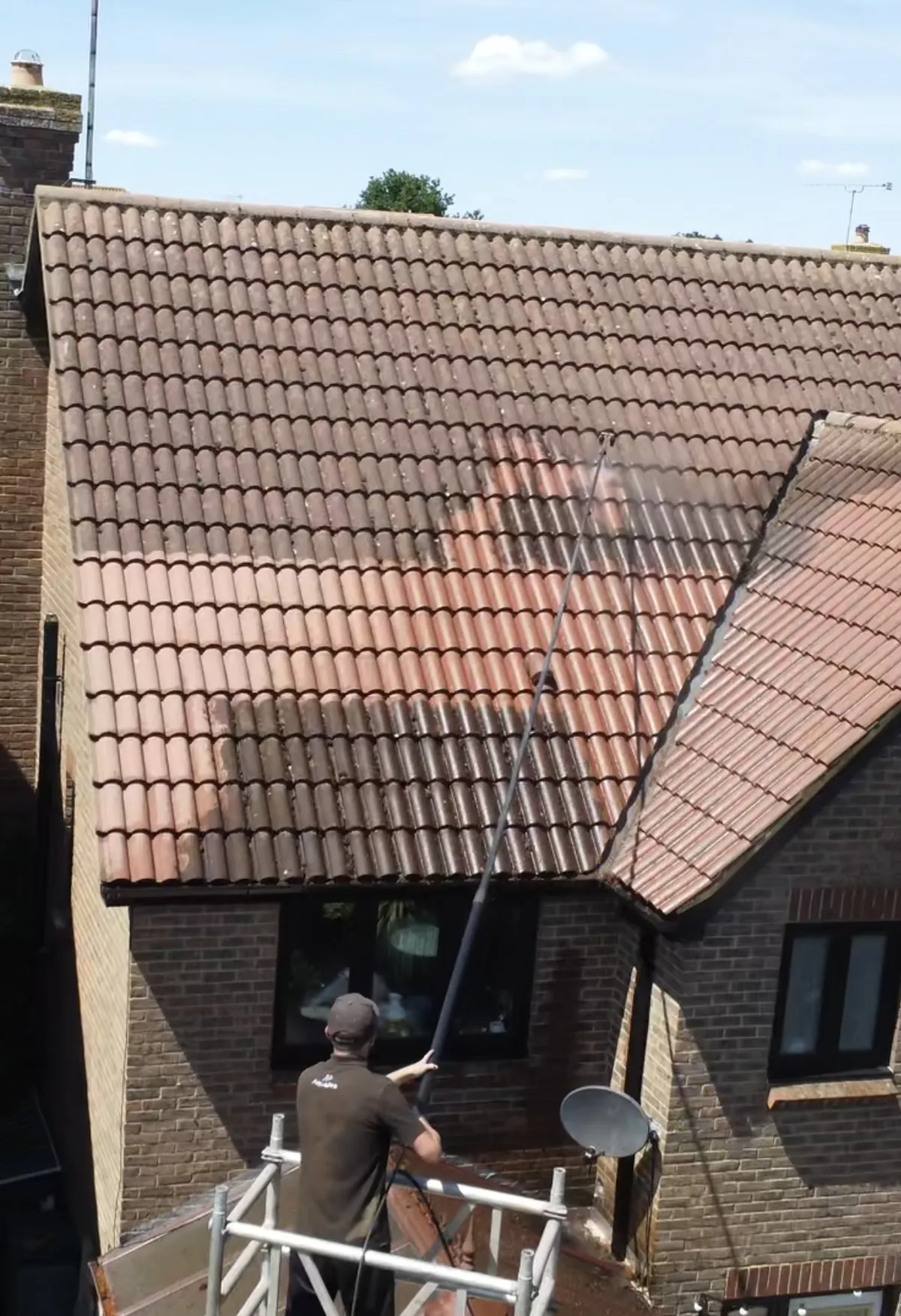
Real photos of real jobs tend to beat polished stock images. Before and after shots work well for cleaning and exterior trades. Pair the photo with one clear offer, like this.
Your speed
Fast replies win jobs. Leads that land in your WhatsApp let you ring while they are still thinking about it. See WhatsApp lead alerts for how that works.
On a job and cannot pick up? Every call your ads create is paid for, so catch it with missed-call text-back or an AI phone receptionist that takes the job details for you.
The season
Demand moves through the year. Cost per lead may rise or fall with it, so compare like with like.